Showing posts with label brief. Show all posts

Sunday

Brothers


We’ve tried phone calls – but they always end up in shouting, somehow.

We’ve tried email – but he said that he’d grown so to dread the ‘cold aggression’ of my tone that he could hardly bring himself to open my messages anymore.

We’ve tried skype – but I found I couldn’t bear staring directly into his beady little eyes for so long a time.

Face to face actually works best, but only because I can usually position myself so that I don’t have to look at him, and can thus constantly retreat into other, more pleasant regions of thought.

And yet we must talk – for a while longer, at least. Family business demands it, and no further evasions can be found.

And along with that, of course, comes a raft of other family obligations: Birthday and Christmas cards: presents, even, however token in nature. All those enforced contacts which gall us most when they seem most arbitrary.

So what to get him for Christmas?

A copy of Emily Post, was my first thought (though it turned out, when I mentioned this jest to someone at work, that no-one appears to recall anymore her undisputed reign over all the intricacies of etiquette).

A film? I’ve tried that before: buying the alleged Sinophile a box-set of Chinese historical epics. But his look of complete incomprehension at the gift persuaded me that this was not an expedient worth repeating.

A book, then? The fact that the books are piled high in his house thick as autumnal leaves that strew the brooks in Vallombrosa [1] might suggest otherwise. Still, where best to hide a leaf? In the forest. What best to buy for a misanthrope? More of what he already has.

A book was accordingly determined on. But what book? Nothing about self-help, that’s for sure: too pointed. There’s no need to escalate the temperature when it’s already at boiling point.

I’d watched a particularly nasty ghost story sometime before: about a vengeful spirit who rejects all attempts to appease her, and instead ends up killing her would-be benefactor.

I’d seen the book it was based on some weeks before, bound up with several other stories by the same hand, in a little bookshop some half an hour away by car.

Having left it so late, the holiday frenzy was already in full spate when I decided to drive over and get it. Crowds were thronging the malls, aggressive motorists the roads. It was fearfully hot – sweatily, stickily hot – and the busdrivers were on strike.

Nevertheless, I duly set out on my fool’s errand, to buy something avowedly useless for someone I don’t like in order to try to persuade him that I do – when all the time he and I both know that all of this is just about the money, a great deal of money, which neither of us wishes to dissipate in lawyer’s fees so long as there’s any chance at all of getting our share by simply watching and waiting … Hallelujah! Deck the halls with boughs of holly, and fa la la la la la la la la (give or take a ‘la’ or two).

It used to be that the fastest way to drive across town was to avoid all the suburban capillary roads by getting straight onto the motorway. No longer, alas.

It took me so long even to get onto the motorway approach the last time I tried it that I’ve taken to putting up with all the 50k speed limits and random old ladies out in their little blue cars in the interests of simply keeping moving (and thus discouraging my sad antique of a car from overheating).

And there’s no denying that it’s more interesting inching one’s way through a built-up shopping centre than one more random stretch of soulless highway.

Which is why, I suppose, I had the leisure to see the ghost.

I say ‘ghost,’ but that is – of course – a supposition. How am I to confirm that it was a ghost, and not a hallucination, or even just a trick of the light in my eyes?

The fact remains that I saw, by the side of the road, my ex-wife standing, parcels in hand, waiting for the pedestrian crossing lights to go green.

Methought I saw my late espousèd Saint [2] … etc. etc. Not Saint, though, never that – but not a face (or a frown) I could ever grow indifferent to, either, no matter how much time had gone by.

And she was frowning, that was the thing: despite all the Christmas trappings around her, all the green trees and red hats and bundles of presents, all those things she most loved, she had that crease in her forehead which denoted distress.

There was nowhere to stop. I suppose I could have abandoned the car and leapt out and run back to accost her, but it was not – in the mundane sense, at least – a feasible manoeuvre. But I could hardly just drive on, either, so I turned down a side-street and came back, by a commodious vicus of circulation, to the same intersection.

Where she was, of course, no longer standing.

Had she ever been there at all? Well, I suppose that it depends in what sense you mean the question. Would she have been visible to anyone else seated beside me? Possibly not. But that doesn’t mean that she hadn’t been clearly apparent to me, despite the fact that I wasn’t thinking about her, and hadn’t – in fact – spent a moment on her for what seemed like years.

I ranged around the shopping centre for a while (having finally found a park in the nearby mall), but with little result, and nothing to show for it besides perplexity.

Could it have been her? There was no real reason why not. Despite the fact that she lived on the other side of the world, in the approximate zone of the white Christmas, she could have made a sudden decision to revisit old haunts at the season of goodwill. Why not, in fact?

I hadn’t heard anything from her, was one reason why not, but then she did have some (fairly distant) relatives here. Perhaps she was visiting them? There was certainly nothing unbelievable in the idea that she wouldn’t trouble herself to make contact with one whom she had somewhat unceremoniously dumped so many years before.

Who knows? The heart – any faint vestiges of heart – had gone out of my errand, but that didn’t seem a strong enough reason to give up on it entirely. In the absence of alternate directions, let inertia carry you in the same trajectory, is the usual rule in these matters. And so I went on.

Backing and filling my way out of the parking building was quite adventurous enough, but given that all that had to be done anyway whether I turned left (towards the bookshop) or right (towards home), I let the ease of the leftward drift carry me on.

Till I saw her dog.

It was a big Briard sheepdog, black as night, called Ajax. I’d never exactly got on with the dog, but we’d maintained mutually respectful relations during most of the time I’d been married. With her, on the other hand (and the rest of the extended family) he’d been on the most rapturously loving terms.

There he was, standing by the side of the road, staring fixedly into space, as if at some imaginary point in the distance (I remembered his uncanny skill at detecting where a car was going whilst still some minutes or miles away from the destination: with intense excitement if it was to see one of his loved ones, dejection if it was merely to the vet or the grooming clinic).

He certainly wasn’t looking at me, and – so far as I could ascertain in the brief glimpse I got of the other side of the road whilst driving by – nor was his mistress anywhere in sight.

I’ve read Phantasms of the Living [3]. I know that most sightings of people who couldn’t possibly be there in the flesh are not at the point of their death, or at the moment they’re on the operating table, or in the grip of some extreme emotion. It can correspond with nothing significant at all – for either the perceiver or the thing perceived.

I also know about fetches: those strange visitations of totem animals or uncanny sights which betoken some ill luck to the beholder. Gunnar’s vision of a hillside covered with blood at the climax of Njal’s Saga, for instance.

What, then, was this? An omen or a happenstance? A meaningful intervention from the paranormal realm – or a mere coincidence?

On I drove, towards the bookshop, towards Susan Hill’s The Woman in Black and Other Ghost Stories, towards my destiny, towards the distinct possibility that my brother would get his way, and all those weighty wads of dosh, to keep as company for himself alone as the night falls and the darkness comes wherein all the beasts of the forest do move [4].


Notes:

[1] John Milton, Paradise Lost, 1l.302-3. Quoted from Paradise Lost. Ed. Alastair Fowler. 1968. Longman Annotated English Poets (London: Longman Group Limited, 1974), 62.

[2] John Milton, Sonnet XIX. Quoted from Complete Shorter Poems. Ed. John Carey. Longman Annotated English Poets. 1st ed. 1968 (London: Longman Group Limited, 1971), 413.

[3] Edmund Gurney, Frederick W. H. Myers & Frank Podmore, Phantasms of the Living. 2 vols (London: Rooms of the Society for Psychical Research / Trübner & Co., 1886).

[4] Psalms 104: v. 20 (Anglican Prayerbook version): quoted in ‘Mr. Humphrey and His Inheritance.’ The Collected Ghost Stories of M. R. James. 1st ed. 1931. Pocket Edition (London: Edward Arnold (Publishers) Ltd., 1964), 340.


Olivia Macassey, ed.: brief 54 (2016)


[20-23/12/2015]

[1512 words]

[Published in brief 54 (2016): 99-104;
Ghost Stories (Auckland: Lasavia Publishing, 2019): 79-82.]

Jack Ross: Ghost Stories (2019)


Saturday

General Grant in Paeroa


Bruce Catton: Grant Takes Command (1969)


I met a girl from Paeroa once. It was in Tahiti, where I was living with a family on a student exchange. She didn’t like me.

She didn’t like me to a quite extravagant extent. I must have said something the first time we met which gave her the impression that I was a snobby Aucklander from the Eastern suburbs, looking down on the poor provincial hayseeds.

Nothing could have been further from the truth, but you know how it is once someone takes a dislike to you? Everything you say from then on somehow conspires to back up their original idea. No matter how hard you try to repair it, the damage has already been done.

Anyway, the reason I mention it here is because there is a popular soft drink here in New Zealand called ‘Lemon & Paeroa.’ It’s a kind of lemonade made (originally, at least – it’s now been bought by the Coca-Cola company, and is bottled elsewhere) with carbonated water from the local spring.

For a long time there was a rather funny TV ad campaign listing things which were ‘world-famous in New Zealand’ – concluding with a silent pan across the huge plaster L & P bottle standing at the gateway to Paeroa.

In an unfortunate moment, when some French kids asked me to describe the town, I referred to it as the ‘drinking capital of New Zealand’ – by which I meant (I swear) Lemon & Paeroa. Overhearing this, though, the girl (whose name escapes me) thought – not unreasonably, I suppose – that I was describing people from Paeroa as a bunch of drunks.

Nothing I said to dispute this interpretation of my innocently meant remark had any effect. I had insulted her native soil, and was therefore the worst kind of arrogant big city aggressor.

Paeroa has done quite a bit to jazz up its Wild West image since then. For a while it made a concerted attempt to market itself as the Antiques capital of New Zealand (perhaps because the L & P label was getting a little tired). The main street filled up with shops selling bric-à-brac of various types, and the whole thing went with a bang – at first.

But Paeroa is quite a long way from anywhere else, and there are antique shops in other towns, too, and it’s difficult to restock often enough to attract return custom after a day of junk-shopping there – and this was pretty high-priced junk, too. So one by one, over the years, they’ve folded, until now there are only a few left of the original squadron of shops offering ceramics, fabric, furniture: and scruffy books.

The second-hand bookshops were probably the first to go. On my last visit there, only about half of those I remembered still seemed to be in business. I did pick up one or two little trifles, though, including a hardback copy of Bruce Catton’s American civil war book Grant Takes Command [1].

I actually walked out of the shop without it, then, half an hour later, had to trace my footsteps back. I put it back in the shelves after seeing how assiduously – almost fanatically – it had been underlined and annotated by its previous owner. It was an ex-library book (from Remuera, probably the snobbiest quarter of snobby Auckland), and had extensive pencil markings on virtually every page.


A book in the hand is worth two in the bush, however, so (on maturer reflection) I decided to pay the couple of dollars they were charging for it.

It was hard for me to imagine that there would be much there that was new, given that I’d already pored over the accounts of General Ulysses S. Grant’s Wilderness campaign in Catton’s trilogy of books about the Army of the Potomac, not to mention his magisterial Centenary History of the Civil War. Nevertheless, when I got home I started to leaf idly through it.

You know, I’m rather glad I did.

It’s a pretty ugly book. Of the cover illustration, by a certain ‘Edward Mortelmans’ (sounds like a pun on ‘mortal man,’ doesn’t it?) the less said the better: Blue & Grey kitsch, concocted for the UK edition of a very American book.

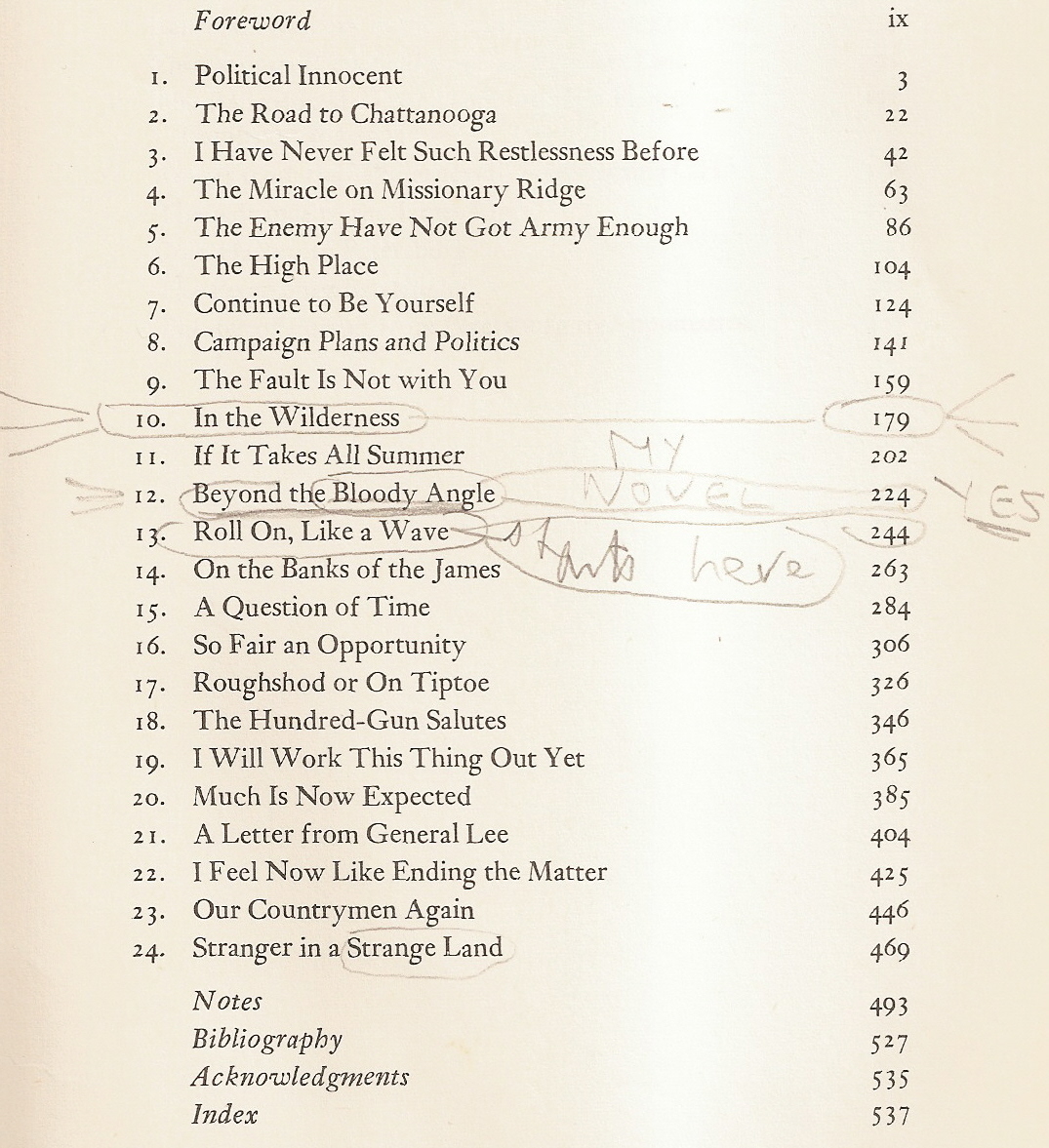
The fly-leaf is distinctly more interesting, though: the list of annotations seems to imply some system to the scribbles and underlinings its former owner had undertaken so assiduously.

There are already odd features to be noted. Why, for instance, does he circle and tick the dedication of Catton’s original book? Has he found out who this ‘David’ is? Or is there a David in his own life whom he would like to commemorate similarly?


Somehow I assumed from the beginning that this annotator was a man, though there’s no direct evidence of it. Perhaps we should call him David, in fact, this anonymous commentator on Catton’s work. I thought at first that it might be the first name of Bruce Catton’s son, who collaborated with him on his 1963 book Two Roads to Sumter, but no, that was William Catton.

Moving on to the Table of Contents:


There it is, unequivocally, written in cold print (in capital letters, no less): ‘MY NOVEL.’ Or should it read ‘MY NOVEL starts here’? Three chapter titles are circled: ‘In the Wilderness,’ ‘Beyond the Bloody Angle,’ Roll On, Like a Wave’ and then the final words, ‘Strange Land’ of the final chapter, ‘Stranger in a Strange Land.’

The novel, then, seems to have been intended to cover the period from the two-day Battle of the Wilderness, through Spottsylvania and Cold Harbor, to the end of the War.

There’s an interesting admission on p. 282 of the text. The ‘night of June 13’ (l. 10 from the top) and ‘following morning, June 14’ (l. 3 from the bottom) are circled, and the words ‘150 years ago’ written at the foot of the page.


150 years added on to 1864 takes us to June 2014. Since I purchased the book in Paeroa on the 9th of January, 2015, this means that sometime in the six months intervening our prospective novelist must have lost faith in his project, bundled up his carefully annotated text, and consigned it to a junkshop.

That’s one theory, at least.

Perhaps the book was stolen. Perhaps he died, and it was the executors of his estate who boxed it up for resale to the highest bidder. Perhaps he actually finished writing the novel he was planning, and thus felt no further need for the research materials so painstakingly gathered along the way.

That last seems unlikely to me, though. I may be more of a packrat than most, but I can’t conceive of disposing of so detailed and important a source just six months after the collection of data for his projected civil war novel had begun. I’m sorry to say it, but a loss of faith in the project – or confidence in his own ability to carry it out still seems the most likely scenario.

It’s not just the 150-year anniversary that appears to have obsessed him, though. Go forward 50 years from 1864, and you arrive at 1914. The ‘pattern of trench warfare’ referred to in Catton’s account of the siege of Petersburg inevitably recall the trenches ‘of WWI.’


Not only that, but if we were to take another fifty-year leap, that would take us to the middle of the1960s, the period of composition of Catton’s book.

There are a number of isolated passages marked with the word ‘novel’ – to be extracted or otherwise drawn upon (presumably) for our annotator’s projected acts of imaginative recreation:


Real, concrete clues as to the nature of the actual nature of the narrative are few and far between, however. We have a number of suggested titles – ‘The Horseman’:


‘That Western Man’:


not to mention ‘A Good Loyal Man,’ all of which might lead us to expect that he meant to write an account focussing on General Grant himself. Perhaps a first-person narrative, even? A little like Richard Adams’ book Traveller (1988), where Robert E. Lee’s horse narrates the tale of his role in the Lost Cause in cod Southern dialect?

The existence of Grant’s own much-praised autobiographical account of the war, completed in the hope of retrieving his family’s blasted fortunes under the shadow of his last heroic fight with cancer, might lead one to see that last plan as somewhat supererogatory, however.

A great deal of underlining has been applied to the very last pages of Catton’s book, where he tries to sum up the effect of the war on those who had fought in it:
One of Sherman’s veterans, going home with all the rest, found that when the armies did melt back into the heart of the people the adjustment was a little difficult. The men had been everywhere and had seen everything. Life’s greatest experience had ended with most of life still to be lived, to find a common purpose in the quiet days of peace would be hard: ‘Old avenues are closed to them, old ambitions are dead, and they walk as in a dream – as strangers in a strange land.’
This latter quote is attributed by Catton to F. Y. Hedley’s 1890 memoir Marching Through Georgia (p. 488). The underlying reference is, though (of course) to the Bible: ‘I have been a stranger in a strange land’ [Exodus 2: 22]. As Catton goes on to say: ‘One of these veterans moving along a shadowed new path after living in a world where he had seen the path so very clearly, was General Grant.’

So what did happen to ‘MY NOVEL’ and the bright hopes that motivated so energetic a ransacking of volume three of this biography of General U. S. Grant?

It is, alas, impossible to say – on the evidence I have, at any rate. For all I know ‘The Horseman’ is with a publisher right now, being readied for the Christmas trade. After all, this may be only one of many tomes our anonymous author pored over whilst creating his great work …

Later That Summer is the title of the (imaginary) civil war novel composed by one of the offstage characters in Stephen King’s rather aptly-titled 1994 novel Insomnia. It was supposed to be an account of what happened to Robert E. Lee’s Army of Northern Virginia after their defeat at the Battle of Gettysburg, and was clearly envisaged as a kind of sequel to Michael Shaara’s classic The Killer Angels (1974): later dramatised (exceptionally poorly), as the four-hour movie epic Gettysburg (1993).

The omni-talented Australian writer Thomas Keneally has also written a civil war novel: The Confederates (1979), about Lee’s first (and equally unsuccessful) invasion of the North, culminating in the Battle of Antietam (or – if you prefer – Sharpsburg).

So there’s nothing inherently improbable or absurd about writing a novel based on the last days of Grant’s campaign in Virginia. Shelby Foote, even, the great Shelby Foote, wrote the single-battle-focussed novel Shiloh (1952) before embarking on his great Homeric trilogy about the civil war.

I may be wrong – very probably am, in fact – but I can’t help wondering if it was the consummate showmanship of Tony Award winner Tony Kushner’s script for the Steven Spielberg film Lincoln (2012) – not released here till 2013 – which put our prospective author off?

There does seem to be a suspicious amount of coincidence with the focus of some of the anonymous underlinings in the Catton book: the emphasis on the Confederate peace mission in the first days of 1865 is common to both, as are many other details. After all, he may not have seen it when it first came out. Perhaps he downloaded or rented it sometime in late 2014, and felt that he’d been gazumped …

Whatever the explanation for his abandonment of the project (or at any rate Bruce Catton’s book), I sometimes feel that I’d like to pick up where he left off – re-enter the Gothic dreamscapes of Cold Mountain, The Beguiled and all those other civil war classics – and write my own tale of Grant’s murderous advance on Richmond in the late Spring and Summer of 1864. It would be a kind of homage to a fellow-worker in the field of fiction (however serious his intentions actually were).

I can’t help feeling, though, that it might be taken amiss: outside appropriation of something better left to natives: another innocent remark about L & P which might come across as dismissive or patronising.

Better, perhaps, to dream of another kind of novel, based on a quite different classic of historical writing, James Cowan’s 2-volume The New Zealand Wars (1922), based on his firsthand interviews with the survivors of our own land wars of the 1840s and 1860s.

Paeroa began as a gold-mining town, built in 1875, long after the wars, on land bought from two local Māori Chiefs, Tukukino and Taraia. Nor was the surrounding region particularly associated with the fighting, being too far east for the Waikato war and too far north for the campaigns of the great warrior prophet Te Kooti Arikirangi Te Turuki in the late 1860s.

There is, however, one intriguing reference to Paeroa in Papers Past, the online repository of so much nineteenth-century pioneer journalism. It comes from the New Zealand Herald for 29 June 1883:


TE KOOTI AT PAEROA, OHINEMURI

I am informed that Te Kooti, and about fifty followers, have visited Paeroa, and besides being the ‘lions’ of the place were masters of the situation. They were impartial patrons of the hotels. A guard was mounted at each, and none of the rank and file were allowed more than a pint of beer. Not so, the doughty chief, his rangatiras, and his secretary. They fraternised with a deputations [sic.] of ‘illustrious’ citizens, and champagne and brandy were quaffed right heartily, and of course friendship pledged. As far as concerns the publicans, the most interesting feature to them will be, who is to pay for the liquor consumed? It was deemed not only proper but essential that due deference should be paid to ‘the man of blood.’ The well-known surveyor, (Mr R. C. Long) was smoking his pipe when the secretary intimated that he must cease to do so in the presence of Te Kooti. Mr. Long promptly complied, but whether as a mark of respect or esteem or an act of discretion, the public have not yet been enlightened. [2]
Te Kooti was pardoned by the government in 1883, shortly before this visit, but was subsequently imprisoned when he attempted to revisit his old home in the East of the North Island. He was released on the understanding that he should not try to return to his old haunts, a decision upheld by the Court of Appeal in 1890. By then it was clear that he was an incurable alcoholic. He died a couple of years later.

The rather facetious tone the Herald’s Thames correspondent uses about this ‘man of blood’ (a phrase last used, if I’m not mistaken, for King Charles Stuart in the English Civil Wars) is typical of late nineteenth-century European attitudes to Māori. No-one was laughing in 1868, when Te Kooti and his men slaughtered 54 settlers at Matawhero, in response (it is thought) to his unjust imprisonment on the Chatham Islands.

General Grant, too, ended badly. His tour of the world at the conclusion of his second term as president took him to New Zealand in 1879, where he too (alas) displayed ‘intemperance’ at a state banquet, and was even accused by a local newspaperman of ogling some of the young girls present with inappropriate zeal.

Perhaps one could contrive some kind of meeting? Te Kooti’s favourite mode of transportation was on a white charger, and Grant, too, was immensely fond of horses. Could they have met out riding, somewhere in the Hauraki Plains, and shared a libation from Grant’s hipflask? Why not, after all?

Whichever way one plays it, though, it’s a pretty sad story: Grant’s solitary last days out on the veranda, labouring away at his memoirs, as penniless and disgraced as he was when the Civil War began. Te Kooti, expelled by the Māori King from the great 1878 peace conference at Hikurangi for breaking the ban on alcohol, reduced to cadging drinks from strangers in the hotels of Paeroa. ‘David,’ our putative author, starting his civil war novel with such high hopes, then discarding the sedulously annotated ex-library book which had inspired it all in a Hospice shop a few short months later.

Let’s honour them all, obscure and famous, rich and poor, invader and native. Conflict brings strange bedfellows. ‘It is well,’ to quote the great Virginian Robert E. Lee, ‘that war is so terrible – we would grow too fond of it!’


Notes:

[1] Bruce Catton, Grant Takes Command. 1st ed. 1969 (London: J. M. Dent & Sons Limited, 1970), vii.

[2] ‘Te Kooti at Paeroa, Ohinemuri.’ New Zealand Herald, Vol. XX, Issue 6744 (29 June 1883), 5. Papers Past: https://paperspast.natlib.govt.nz/newspapers/NZH18830629.2.39.


Olivia Macassey, ed.: brief 56 (2018)


[12/9-24/11/2015]

[2796 words]

[Published in brief 56 (2018): 97-107;
Ghost Stories (Auckland: Lasavia Publishing, 2019): 69-78.]

Jack Ross: Ghost Stories (2019)


Wednesday

Leaves from a Diary of the End of the World


Michael D. Coe: Breaking the Maya Code (1982)


The world was so recent that many things lacked names, and in order to indicate them it was necessary to point.
– Gabriel García Márquez, One Hundred Years of Solitude [1]


Tuesday, 21 February, 2012:

Today I found an old book in the library, in the de-accessioned pile. It cost me two dollars to buy it (Hardback Non-fiction – if it had been Fiction, it would only have been a dollar). The title was Breaking the Maya Code, by Michael Coe.

But why on earth were they throwing it out?

It’s true that this was a copy of the first, 1992, edition, and since then – I checked – Coe has gone on to publish a number of revisions of his book (just as he did with his 1966 text The Maya, now in its eighth edition). So perhaps they thought it was too out of date to be useful.

What I suspect, though, is that they read those words ‘the Maya Code’ as something analogous to the Da Vinci Code – as a reference to the (alleged) Mayan Prediction of the end of days in December 2012.

If so, they were sorely mistaken. Far from an Occultist text full of babble about the Apocalypse, Coe’s is a profoundly scholarly work, which tells the tale of one of the great decipherments in history.

The name of Yuri Valentinovich Knorosov, the Russian genius whose phonological and comparative methodology finally led to success in this two-hundred-year-old quest, should undoubtedly go down in history along with Jean-François Champollion, Michael Ventris, and other heroes of the intellect.

The fact that we can now actually read these texts from a far-off civilisation, mute for centuries, thanks solely to such feats of ingenuity is one of the few proofs I know that the cosmos is not entirely arbitrary.

Just as the patterns of Nature become clear over time when examined by the dispassionate intellect, so advances can be made in our knowledge, the stones can be made to speak.


(Funnily enough, when I tried to find the book again to verify these references, it had disappeared into the jungle of my too well-stocked shelves. Perhaps because its work was done; perhaps because paying too much attention to the glyphs themselves might become, in its turn, a distraction from the main event: the culmination of this present cycle of ours.)


Monday, 8 October, 2012:


This is a map of the tunnels of the Lizard People under Los Angeles.

That may sound a bit unlikely. I’m sure you’ve all heard about the tunnels under North Head, full of old wartime ammunition dumps (as well as the two first Boeings ever built), but the idea of ‘lizard people’ probably strikes you as coming straight out of Science Fiction.

There really was a cover story about them in the Los Angeles Times for January 29, 1934, though. A mining engineer claimed to have discovered traces of them with a ‘radio X-ray’ device he’d built to detect ‘minerals and tunnels below the surface of the ground.’

Further details came from a Hopi Indian chief in Arizona, who told him that the tunnels were the remains of one of three lost cities built after ‘the ‘great catastrophe’ which occurred about 5000 years ago’:
This legendary catastrophe was in the form of a huge tongue of fire, which ‘came out of the Southwest, destroying all in it’s [sic.] path ... the path being several hundred miles wide.’ The city underground was dug as a means of escaping future fires. [2]
Interestingly, the engineer, G. Warren Shufelt, disappeared shortly after this article appeared, and has never been heard from since.

1934 AD[the year the article appeared]
– ‘5000 years’[the approximate time elapsed since the fiery ‘catastrophe’]
3066 BC

It seems a bit more than a coincidence that this date is within less than fifty years (48, to be precise) of 3114 BC, the (alleged) date of commencement of the fourth creation in the Mayan count.

If we measure back from 2012, we can see just exactly how far Shufelt’s discovery was ahead of its time: 78 years, to be precise. Perhaps that’s why he had to disappear: if people had known that another catastrophe was coming, they might have panicked and run amok (as they did a few years later, after Orson Welles’ infamous radio adaptation of H. G. Wells’ War of the Worlds in 1938, on the brink of the Second World War).


Wednesday, 23 December, 2012:

Michael Coe ends Breaking the Maya Code as follows:
The Maya wise men all across Yucatán predict that the world will end in the year 2000 y pico – ‘and a little.’ How many years will that ‘a little’ be? The Great Cycle of the Maya calendar which began in darkness on 13 August 3114 BC will come to an end after almost five millennia on 23 December AD 2012, when many of you who read this will still be alive. … And what is to happen? A Katun prophecy in the Book of Chilam Balam of Tizimín reads:
Ca hualahom caanThen the sky is divided
Can nocpahi petenThen the land is raised
Ca ix hopp iAnd then there begins
U hum ox lahun ti kuThe Book of the 13 Gods.
Ca uch iThen occurs
No hai cabilThe great flooding of the Earth
Ca lik iThen arises
Noh Itzam Cab AinThe great Itzam Cab Ain.
Tz’ocebal u thanThe ending of the word,
U uutz’ katunThe fold of the Katun:
Lai hun yeciilThat is a flood
Bin tz’oce(ce)balWhich will be the ending of
u than katunthe word of the Katun. [3]
It’s pretty clear from this that the catastrophe will take the form of a flood.

And so it has.

Is it any accident that even the most conservative predictions have the sea-levels rising between 56 and 200 cm (22 or 79 in) during the 21st century? Whereas the melting of the Greenland and Antarctic ice sheets, could contribute 4 to 6 m (13 to 20 ft) or more to present levels.

Try to imagine what that means the next time you go to the beach. First add seven feet, the height of the tallest man, to the high tide levels you see marked on the sand. What would be left of the coastal community behind you? Then expand it to twenty feet. What would remain of the surrounding towns and suburbs?

The end is near, make no mistake about it. As with the lost land bridges between the straits of Gibraltar, the Bosphorus, the waters will flow in gradually, but the result will be a new sea: a new Mediterranean, a new Black Sea. We may not see it yet but it is coming. Our futile attempts to hold it off were always that: futile.

Better, instead, to beat the bounds of the new dispensation: learn to read the signs of the coming age in a hundred everyday things.


Sunday, 6 January, 2013:

I was struck today, while reading L. Frank Baum’s The Marvelous Land of Oz, by the following passage. Tip, the young boy who will be transformed into a girl (‘Ozma’) at the end of the story, explains how you can always know exactly where you are in Oz:
… in the Emerald City everything is green that is purple here. And in the Country of the Munchkins, over at the East, everything is blue; and in the South country of the Quadlings everything is red; and in the West country of the Winkies, where the Tin Woodman rules, everything is yellow. [4]
There’s even a map included in the endpapers to illustrate the idea.

The Maya, too, saw each of the four directions as governed by a particular colour. Admittedly they were slightly different from L. Frank Baum’s, but the basic concept was the same:


WHITE for the North – of ice and snow; RED for the East – where the sun comes up; BLACK for the wild oceans to the West; YELLOW for the deserts of the South, with BLUE­GREEN at the Centre – for the lands of men.

Michael Coe’s book The Maya, which I took this picture from, goes on to explain some of the principles behind their multiplicity of gods:
Exceedingly little is known about the Maya pantheon. That their Olympus was peopled with a bewildering number of gods can be seen in the eighteenth-century manuscript, ‘Ritual of the Bakabs,’ in which 166 deities are mentioned by name, or in the pre-Conquest codices where more than thirty can be distinguished. … First, in the case of certain gods, each was not only one but four individuals, separately assigned to the color-directions. Secondly, a number seem to have had a counterpart of the opposite sex as consort, a reflection of the Mesoamerican principle of dualism, the unity of opposite principles. Thirdly, some seem to have had young and old aspects, or (especially in Classic times) fleshed and fleshless guises. Fourthly, there was no clear dividing line between humans and animals, or even between species of animals, so that many supernaturals combine these elements in fantastic ways. And lastly, every astronomical god has an Underworld avatar, as he died and passed beneath the earth to reappear once more in the eastern sky. [my emphases] [5]
Young and old, male and female, fleshed and fleshless – it’s like that thought experiment of placing grains of wheat on a chessboard. One grain goes on the first square, two on the second, four on the third … before you reach the sixty-fourth square, the grains of wheat you need will outnumber all the atoms in the universe.

Or all the words, the names, in every human language?

For Tip to become Ozma, the sexes, like the sky, must reverse. Are there other lessons concealed in Baum’s books, frivolous though they appear on the surface?

Is there something encoded there about self-sacrifice, like the ‘spotless virgin’ in the Mayan hunting song?


Wednesday, 6 February, 2013:

I’ve had this little paperback for years: La literatura de los Mayas: Mayan Literature. There’s a companion volume of Aztec Literature. They’re both in Spanish, published in the 1960s.

I was looking through it the other day when I came across this poem. It was collected from among the Lacandon Maya tribesmen by a couple called Phillip and Mary Baer, and published by them in the Academic Journal Tlalocan in 1948:

Lacandon-Maya Poem


Every time I lift my foot
every time I lift my hand
I shift my tail

I hear your voice from far away

I’m searching for a fallen tree
tired now
I’ll fall asleep on the fallen tree

My skin

My ears
my hands
my feet
are scratched


– Demetrio Sodi M., La literatura de los Mayas (1964) [6]


Wednesday, 13 February, 2013:


I was walking along Jervois Road, away from Ponsonby – Pon-snobby, they call it – when I happened to glance in the window of an art gallery.

There were five pink shelves there, each with ceramic books, pyramids, and candlesticks balanced on top of it. The artist seemed to have taken all the things she’d read and turned them into pottery statues of themselves: there were titles like ‘Monster und Menschen in der Maya Kunst’ and ‘Lord Smoking Squirrel’s Cacao Cup.’

I’ve made a little sketch-plan of the layout.
  • One of the candlesticks had Adam and Eve reaching up into a tree for the forbidden fruit, with the serpent hovering above them.
  • Another one had a lot of leaves attached to its branches, each one with the word ‘leaf’ written upon it.
  • There were a couple of strange melty-looking books with candle sticks growing out of them.
  • Most striking of all, there were stacks of clay books in the form of Mayan pyramids.
I wanted to go inside and ask the artist about her work, but there were a lot of guests milling around with drinks in their hands, together with the other two artists in the show, and I could see that some of them were already looking at me as if I shouldn’t be there, even though I was just standing outside in the street looking in.

I could hear some of what they were talking about, though:

– It’s a terrible film [someone was saying].

– Terrible? What do you mean? It’s fantastic! Priestesses in flowing white robes – Sean Connery in leather – Civilisation vs. Barbarism … and then there’s that bit where he’s in the library, looking at the books, and the penny finally drops: ZARDOZ, their god, is really the WiZARD of OZ … so then he goes mad and starts tearing the whole place up …

– But it’s so cheesey

‘I’ve seen it myself!’ I wanted to shout at that point. On late night television, years ago. Every time there was an ad break you’d see that motif of the great floating face turning to show the priestesses inside. But I didn’t dare. They all looked too cool.

I could see that she knew, though. I guess that must have been the artist herself. She knew about Oz, about the Mayans, the whole kit and caboodle. She wasn’t putting down the movie Zardoz, or laughing in other people’s faces … I wish I could have talked to her about it, but I wasn’t ready. Not just then, anyway.

And I would have especially liked to take some pictures of her beautiful works on my phone, but I know that gallery people don’t let you do that – I’ve been warned about that before.

What I felt, though, looking in on her show, was a fierce pleasure in finding this proof that I wasn’t the only one who knew – that others were already at work, outlining the new order, laying out a new heaven and a new earth where male can be female, up can be down, the serpent a hero and the pyramid a book.


Wednesday, 13 February, 2013:

Tzotzil-Maya Prayer


Green fire
aërial fog
be epilepsy
yellow fire
be epilepsy
north wind
be epilepsy
narcolepsy
white mist
be epilepsy

I repel it
repel it nine times
I expel it
expel it nine times
pacify it
pacify it nine times
Lord
in an hour
half an hour
fly away
into the fog
fly away
as a butterfly

Slow your big pulse
slow your small pulse
both of them
within the hour
half an hour
So be it
Lord
send it away
over thirteen mountains
over thirteen hills
stop at thirteen rows of rocks
stop at thirteen rows of trees


– Demetrio Sodi M., La literatura de los Mayas (1964) [7]


Tuesday, 12 March, 2013:

There’s an ad today on the University of Auckland website:
Oxlajuj B’aqtun:
not the end but a new beginning for Maya,
Indigenous Peoples and the Earth

On 21 December, 2012, Maya communities across the Americas celebrated the end of the Fourth Era and welcomed the Oxlajuj B’aqtun, the Fifth Mayan Era. The Maya Calendar is the oldest extant calendar on the planet, with a 5,200 year cycle of remarkable accuracy and complexity. However, across the planet, from the US to Russia, citizens panicked at the idea that the world would end ‘as predicted by Maya astronomers’. This was a Western invention; this change does not predict the end of time but promotes continuity at a time of crisis. In his talk, Professor Arias will explain the workings of the Maya Calendar, the celebrations last December, and the way indigenous peoples throughout the Americas understand this momentous event as a starting point to reconfigure an ethical beginning for their own people, to promote an indigenous worldview on Earth, to advance decolonial processes, strengthen indigenous cultures, and protect Mother Nature in significant ways. [8]
Could that actually be true? Did the world come to an end on 21st December 2012, the end of the 13th b’ak’tun in the Mayan Long Count. Professor Arias claims that ‘this change does not predict the end of time but promotes continuity at a time of crisis.’ But what does that mean?

People still seem to be walking around, conducting their business – loving, dying, praying, giving birth – just as they have been since August 11, 3114 BC, when the present era began.

A few points to remember:
  1. All this has happened before: three times, in fact. However, according to the Popol Vuh, the Holy Book of the Quiché Maya, ours, the fourth creation, is the first wherein the gods have succeeded in keeping humans and animals alive for any length of time.
  2. Secondly, note the close coincidence of that date with Sunday, October 23, 4004 BC, Bishop Ussher’s 17th century calculation for the exact Date of Creation, still to be found in many old Bibles – admittedly there’s a difference of 890 years, but that’s surely a permissible deviation, given the tentative nature of the evidence.
  3. After all, John Lightfoot, Ussher’s predecessor, calculated the beginning of things at 3929 BC; the Talmudic scholar Yose ben Halafta at 3761 BC; the Venerable Bede at 3952 BC; the French scholar Joseph Scaliger at 3949 BC; the Cosmologist Johannes Kepler at 3992 BC; and Sir Isaac Newton at c. 4000 BC. All within cooee of the Mayan figure.

It reminds me a bit of Gabriel García Márquez’s Macondo, in One Hundred Years of Solitude, after the epidemic of insomnia that afflicted the early settlers:
At the beginning of the road into the swamp they put up a sign that said MACONDO and another larger one on the main street that said GOD EXISTS. In all the houses keys to memorizing objects and feelings had been written. But the system demanded so much vigilance and moral strength that many succumbed to the spell of an imaginary reality, one invented by themselves, which was less practical for them but more comforting. [9]
‘Thus they went on living in a reality that was slipping away, momentarily captured by words, but which would escape irremediably when they forgot the values of the written letters.’


Tuesday, 19 March, 2013:

– You can see that paint is going to peel off in a couple of years. I know they used to market that stuff as permanent-coat, one size fits all, but that’s not really practical in a climate like this.

– We did tell her at the time. She wouldn’t listen, though.

– So she was a bit of a gardener, was she?

– Back in the day, yes. Not after the cataracts got really bad. And she found that walking down to the shops was getting harder and harder.

– A bit like my Dad.

He pauses, groping instinctively for a rollie from his front pocket, then remembers he’d agreed to give up a couple of years ago now. The reflex still won’t quite quit.

– I ran into my brother in town one day. I mentioned that I’d been summoned upcountry for yet another deathbed scene. ‘So the old man’s still dying,’ he said. And that was right. It must have been a good fifteen years of phone-calls to come up and see him for the last time. And then one day it actually happened.

– Not my Gran. She was pretty cogent right up to the end. She checked herself into a rest-home, got rid of all her stuff, piece by piece. I’ve still got a few of her books lying round.

The two men look down at the inlet below, framed by dark-green trees.

– I guess she knew all along what ‘permanent’ means …


Saturday, 23 March, 2013:

Yucatán-Maya Hunting Song


Hunter from the mountains
hunt
at the edge of the grove
once
twice
dance
three times

Lift your face
look carefully
make no mistake
about your prize

Have you sharpened your arrows?
Have you strung your bow?
Have you stroked your shaft
with catzim resin?
Have you greased your arms
your feetyour knees
your calvesyour ribs
your waistyour chest
with buck-deer fat?

Lap three times
the coloured stone
where the spotless virgin
youth
is tied

Firstrun
second
take your bow
nock your arrow
against his chest

shoot him
– not so hard as that! –
let him suffer
as God wills

Lap again
the blue-green stone
shoot him again
but don’t stop dancing
that’s how we measure
warriors
men pleasing
in the eyes of God

The sun breaks through
the eastern trees
the archer starts to sing
his song
learning to be
a warrior
learning to run and dance
and kill


– Demetrio Sodi M., La literatura de los Mayas (1964) [10]


Sunday, 14 April, 2013:

‘Dear me!’ said Jack. ‘I’m getting confused with all this history. Who is the Scarecrow?’
– L. Frank Baum, The Marvelous Land of Oz (1904) [11]

‘Citizens of the sweet hereafter.’

That’s what the girl says at the end of one of my favourite films, The Sweet Hereafter, made in Canada in 1997.

She’s sitting by a ferris wheel, I think, or some kind of fairground ride.

The film is about a small town where a school bus goes off the road and gets trapped under the ice of a frozen lake, so most of the children in the community are drowned. For the rest of them, the survivors, it’s as if time has stopped. All they can think about is what they’ve lost.

In another way, though, nothing can touch them now: the worst has already happened, and anything they can think of doing seems futile in advance.

The girl, played by Sarah Polley, has been disabled by the crash, and has to get around in a wheelchair. It’s as if she’s re-enacting the fate of that one child left behind by the Pied Piper in Robert Browning’s poem.

She’s a singer, too – at one point she sings a song with the repeated refrain, ‘Courage!’

She needs quite a lot of courage herself, because – on top of everything else – she’s being sexually abused by her father.


It’s hard to explain why that film had such a strong effect on me when I first saw it. I know it sounds pretty dark.

Now, though, when I think of us, picking ourselves up and dusting ourselves off after the End of Days, I think of that girl, that town of people caught in the sweet hereafter, where all bets are off, all the rules have changed, and – new Adams, new Eves – we have to find the courage somehow to start naming the strange new things we see.


Notes:

[1] Gabriel García Márquez, One Hundred Years of Solitude. 1st ed. 1967. Trans. Gregory Rabassa, 1970 (London: Picador, 1980), 9.

[2] ‘Ancient ‘Lizard People’ Underground In LA?’ Reptoid.com.

[3] Michael Coe, Breaking the Maya Code (London: Thames and Hudson Ltd., 1982), 275-76.

[4] L. Frank Baum, Journeys through Oz: The Wonderful Wizard of Oz & The Marvelous Land of Oz. 1st eds 1900 & 1904. Illustrations by W. W. Denslow & John R. Neill (Leicester: Galley Press, 1982), 35.

[5] Michael Coe, The Maya. 1st ed. 1966. (London: Thames and Hudson Ltd., 2011), 223-24.

[6] ‘Lacandon-Maya Poem’ (trans. 6-23/3/13). Demetrio Sodi M., La literatura de los Mayas. 1st ed. 1964. El Legado de la América Indígena (México: Editorial Joaquín Mortiz, S. A., 1974), 81.

[7] ‘Tzotzil-Maya Prayer’ (trans. 6-23/3/13). Demetrio Sodi M., La literatura de los Mayas, 89.


[9] García Márquez, One Hundred Years of Solitude, 46.

[10] ‘Yucatán-Maya Hunting Song’ (trans. 6-23/3/13). Demetrio Sodi M., La literatura de los Mayas, 34-35.

[11] Baum, The Marvelous Land of Oz, 35.


Alex Wild & Brett Cross, ed.: brief 53 (2015)


[6/2-27/4/2013]

[3728 words]

[Published in brief 53 (2015): 80-97;
‘Lacandon-Maya Poem,’ ‘Tzotzil-Maya Prayer,’ and ‘Yucatán-Maya Hunting Song’ were published in brief 49 (2013): 60-65;
Ghost Stories (Auckland: Lasavia Publishing, 2019): 35-52.]

Jack Ross: Ghost Stories (2019)


Tuesday

The Cat


Brett Cross & Bill Direen, ed. brief #36 CD (2008): 7.


It’s harder to post letters than I thought. I’ve had to do it before, of course. I was programmed to take dictation, spell-check, grammar-check. I’m a secretary model. But writing to you is different. I want to tell you everything, but I don’t know how to do it.

I told you about the party, but now I realize that I didn’t even say why. You know that I work for Marta, but I didn’t say how long I’ve been doing that, or who I am really.

I’ve had a friend before. Not a person, not like you. There was a little cat who lived with me. It wasn’t with Marta, it was before. I’ve had a lot of masters and mistresses. Some of them were kind to me and some were cruel. I don’t really want to write about all that.

I don’t need to sleep, but I have to have a place to restart and absorb new data. One hour a night is a minimum, but every few weeks I need to do a total shutdown and reboot (and once a year I have to be examined by a representative. That’s happened to me a number of times now).

Marta gave me a cupboard for my own when I first came to her. She told me to clear out all the files and boxes, and told me that I could store my clothes and anything else I wanted to keep in there. There’s a hook for me to hang myself on when I do my restarts, and shelves and hangers for the coats and dresses. There’s even a bulb and a light-switch, but I don’t need light.

Before I met Marta, before she bought my contract, I used to live in a block of flats. I was the concierge for a four-floor building. Most of the people living there were young couples, and they couldn’t afford a fulltime servant. So all the people living on that staircase got together and each bought one seventh of my time. I had to spend three hours a day in every flat, and I would spend the night each day of the week with a different master or mistress.

There was a garden out the back where I used to hang washing.

And one day, while I was down there, I met the cat.

He was a little white cat, quite dirty, and he had a limp. I think he must have been quite young. I didn’t speak to him, but I knew that he was there. I could see his big eyes staring out at me from a mass of briars.

Later that day, when I came down to take in the washing, he was still there. This time he crept out and looked at me again. I didn’t move, but he ran back as if I had.

He was afraid of me, I thought. But then I realized he was hungry! None of the couples living on my staircase had children, but I’d seen some playing in the park across the way, and their nurses were always giving them food and drink, ice-cream and sweets.

I don’t really need to eat, though I do have to inject myself with supplements every day or two, so it took me some time to think of what I could give the cat. Finally I managed to steal some table-scraps, and I also took some milk. Babies like milk. I know that – basic training.

The little cat seemed quite pleased with what I had brought him. He ate it all up and lapped up the milk form the concrete path, and then he started to growl and rub against me as if he wanted more. I had no more to give, but every day I would come down with some bits of food and a saucer of milk, and he would come out and eat it all up and rub against me. I worked out after a while that the growling meant he was full.

But then he wanted to come inside with me.

I told him he couldn’t come in. That the people would see him and they’d punish me and probably him as well, but he was only a little cat and he didn’t understand. He’d play around the door when I tried to shut it, and it was very hard to shut it again and leave him outside.


I told you I had to stay in a different flat every night. Mostly I stood in the corner when my work was done. I’d give myself my shots and then turn off.

Some of the men would do things to me. Some of the women, too. But most of them were couples, and the men slept in the same beds as their wives.

There was one flat, though – the top flat, the biggest of the seven (all the other floors had two flats each; only the top floor was lived in by one person). He was away a lot, and he had so much space that he’d set aside a whole room for me to use!

It was wet and cold in the garden, and the little cat shivered and sneezed so much that I began to think I might be able to hide him in that room.

It was stupid. I know that now. But the first time I carried him in there and put him down in the corner and he butted me with his little head, and I knew that I could keep him there with me all night, I felt as if I’d never be sad again.

I told him lots of things. Things I’d done, places I’d been, dreams I had, and he never answered me – just looked up with his big eyes and rubbed against me. I’d never had a friend, or even known that I could have one, but it made me feel happy.


One day when I went up to the room to feed him he was gone. I looked everywhere for him but couldn’t find him. Then, when I was looking through the rubbish bins (he used to sniff around them sometimes, looking for food to eat) I found him wrapped up in a black plastic bag.

His pretty white fur was all muddy and stiff and I could see that someone had broken his neck. He had a snarly look on his face as if he’d been very frightened, and that made me feel frightened, too. I was afraid that they’d ask me about him and that they’d find out he was my friend.

No-one ever asked, though, and a bit after that, when my contract was up for renewal, Marta outbid the flats. I didn’t know, then, but she was a friend of the man in the top flat, the man I hardly ever saw. He’d told her about me and that was why she brought me.

“No friends, or pets – or cats,” she said to me when I first moved here. That gave me a strange feeling. Did they know about it all along? About the cat? The man in the top flat, the couples in the other rooms? Did they talk about me and my little friend the cat? Was it too much for them that I should have a friend?

He didn’t do any harm. He never scratched anything except the old blanket I found for him, and he hardly made any noise. I kept him clean and tidied up after him. I wanted to ask Marta about it but I knew she wouldn’t tell me.

I wanted to help the cat, feed him, give him a home. Instead I killed him.

I don’t want to do that again.

That’s why I chose you.


your sister, Eva


Bill Direen & Brett Cross: brief #36 – The NZ Music Issue (2008)


[15-22/8/06]

[1301 words]

[Published in brief #36 (2008) – The NZ Music Issue: 31-40;
EMO (Auckland: Titus Books, 2008).]

Jack Ross: EMO (2008)


Wednesday

The Purloined Letter


Charles Baudelaire: Œuvres complètes (Bibliothèque de La Pléiade, 1975)


1 – The Facts


À Madame Aupick
[Paris.] Mercredi 20 juillet 1859


Je t’écris très sommairement. J’ai trouvé tes deux lettres à la
Revue française, et si je ne t’ai pas répondu plus tôt, c’est que je reste quelquefois trois ou quatre jours sans y aller.

Mes affaires vont à peu près bien. — Sauf la question terrible des dépenses. — J’ai payé
mille francs de dettes urgentes, mais j’ai reçu beaucoup plus, et, comme arrivé a l’état de provincial, je souffre horriblement de cette nécessité de dépenser 20 et 30 francs par jour. Je ne quitterai Paris qu’après avoir résolu la question du Drame; je te récrirai a ce sujet. — Si je n’avais pas été réellement contraint de venir à Paris, je n’y serais pas venu. Ce n’est pas seulement les dépenses qui m’affligent, mais, ce qui est plus grave, l’impossibilité de clairvoyance et de concentration de ma pensée. Je suis étourdi, abruti, abêti; tu sais que j’avais pris l’habitude d’une pensée lente et patiente, l’habitude des journées heureuses.

Je ne puis pas, tu le comprends facilement, te développer l’emploi de mes journées, minutieusement. Ce qu’il faut avouer, c’est que dans cette maudite ville, inondée de chaleur, de lumière et de poussière, il faut retourner plusieurs fois chez chaque personne dont on a besoin pour la trouver. Ainsi, le travail a disparu, et mon envie de revenir est excessive — car, si les dépenses monstrueuses me tourmentent, il y a quelque chose qui me tourmente bien plus, c’est la fuite des journées sottement employées.

Ta seconde lettre m’a profondément touché. Tu sais que je ne brille pas (en apparence du moins) par la sensibilité; ainsi tu peux prendre pour véridiques les paroles que je t’écris. C’est une chose vraiment douce, au milieu de tant de chagrins réels, de découragements, de sentir, auprès de soi, une bonté et une charité qui veille. Toutes les folies maternelles que tu m’as écrites, même ton cidre (
qui n’est pas une chose pressée) m’ont ému. Comment se fait il qu’avec un coeur si bon et si délicat, tu sois quelquefois si maladroite?

Les dix derniers jours (car je ferai en sorte de revenir au commencement d’août, et je te préviendrai quatre jours ou trois jours d’avance) seront employés a me procurer pour la troisième fois, une forte somme d’argent, et à prendre des engagements nouveaux avec une
Revue suisse, de Genève. Le futur directeur du Cirque est malheureusement en Normandie. Tu devines les lenteurs forcées. Il s’agit de la grosse affaire.

Pour comble de malheur, la politique est à l’orage, a l’angoisse, a l’inquiétude. Tu ne peux te faire une idée du désordre créé par l’empereur dans tous les esprits et de l’effet désastreux causé par la Conclusion de la Paix.

Il y a eu des malheurs à la
Revue française; tu vas recevoir coup sur coup deux numéros, dont l’un contiendra tout le reste de mon Salon.

Je t’aime et je t’embrasse, et je te remercie de nouveau de ta dernière lettre.

Je demeure jusqu’à la fin du mois: hôtel de Dieppe, rue d’Amsterdam. J’y suis aussi mal que possible.
CH. BAUDELAIRE. [1]


To Mrs. Aupick
[Paris]. Wednesday 20 July 1859


I’m writing to you very cursorily. I found your two letters at the Revue française, and if I haven’t replied before, it’s because I sometimes go three or four days without going there.

My business is going reasonably well. – Except on the terrifying level of expenses. – I’ve paid 1,000 francs of urgent debts, but I’ve now incurred a lot more, and as I’m now acclimatised to the provinces, I suffer horribly at the necessity of forking out twenty or thirty francs per day. I won’t leave Paris until I’ve settled the question of the Play; I’ll write to you again about that. – If I hadn’t been absolutely forced to come to Paris, I never would have come here. It’s not just the expense that irritates me, but something far worse: the impossibility of seeing and thinking clearly here. I’m battered, bruised, bewildered; you know that I’d formed the habit of thinking things through slowly and patiently, the fruit of contented days.

I can’t, you’ll appreciate, describe how I spend my days to you in minute detail. What one is forced to realise is that in this accursed city, drowned in blinding heat and dust, it’s necessary to visit each person several times before finding them in. As a result, the work I can get has dried up, and my anxiety to get out of here gets stronger and stronger – because, even if the monstrous expense gets on my nerves, there’s something which torments me still more: wasting days in a nonsensical way.

Your second letter touched me deeply. You know that I don’t shine (superficially, at least) in expressing my feelings; so you can take it that what I’m writing to you now is completely sincere. It’s a really sweet thing, in the middle of so many real sorrows and discouragements, to feel, when I’m near you, your goodness and loving kindness watching over me. All the motherly anxieties you’ve poured out to me, even your cider (which is hardly urgent) moved me. So how is it that with such a good and caring heart, you can still be so clumsy sometimes?

The next ten days (because I’m planning to return at the beginning of August, and will tell you exactly when four days or three days in advance) will be employed in getting myself a good sum of money, for the third time, and in making a deal with a Revue suisse in Geneva. The new director of the Cirque theatre is unfortunately in Normandy. You can guess how this enforced idleness grates on me. It’s all in reference to my most important piece of business.

To add insult to injury, the political situation here is troubled, stormy, confused. You can form no conception of the anxiety the Emperor has given rise to in everyone’s mind, and of the disastrous effect of the Peace Treaty.

There have been some problems with the Revue française; you’ll be receiving two issues, one after the other, one of which will contain the rest of my Salon article.

I love you and kiss you, and thank you again for your latest letter.

I will be staying till the end of the month at the Hotel Dieppe, rue d’Amsterdam. I’m as uncomfortable there as it’s possible to be.
Charles Baudelaire. [2]


2 – The Letter


2 – The Letter


Scott Hamilton gave it to me. He said it belonged to some friends of a friend of his whom he’d stayed with whilst backpacking through France. He mentioned to them that he was interested in poetry, so they showed him – with elaborate precautions – a (so-called) genuine manuscript letter of Baudelaire’s which had been passed down in the family.

Scott was very excited by this discovery, and managed to persuade them (later, after he’d returned to New Zealand) to send him a photocopy of the text. It was this photocopy he passed on to me, as his French is somewhat less than proficient. He was under the impression that it was still unpublished.

It wasn’t, of course.

After making a few attempts to decipher the dreadful handwriting, I went to the university library and checked through the Pléiade edition of Baudelaire’s Correspondance, ed. Claude Pichois and Jean Ziegler. 2 vols. Paris: Gallimard, 1973 (rev.ed. 1993). Sure enough, there it was. On pp. 588-89 of the first volume.

Even more interestingly, the notes (p.1021) record that:
Elle a été reproduite en de nombreux fac-similés qui ont trompé d’innocents acquéreurs. [It has been reproduced in numerous facsimiles which have duped innocent collectors.]
Collectors like Scott’s French friends, presumably.

And what is the letter about? It’s addressed to Baudelaire’s mother, Mme Aupick. It dates from the period after his conviction for obscenity (six of the poems in the original edition of Les Fleurs du Mal [Flowers of Evil] were ordered to be excised – printer, publisher, and author were all fined for offences against public morals). The poet had now turned to Art criticism (“The Salon of 1859,” mentioned above) and translation – principally of the works of Edgar Allan Poe, for whom he had an unbounded enthusiasm – as alternative sources of funds. He also, it appears, had ambitions of making money in the theatre (the play mentioned above, Le Marquis du 1ère Houzzards [The Marquis of the First Hussars], was – fortunately or unfortunately – never produced).

Banal, quotidian, intimate by turns, it’s fairly typical of his correspondence: complaints about money, about Paris, about politics. There’s nothing in it that makes it an obvious candidate for forgery. Superficially, at any rate.


Edgar Allan Poe’s “The Purloined Letter” is the last of three stories he wrote featuring his super-intelligent alter-ego, the Chevalier Auguste Dupin, who is described in “The Murders of the Rue Morgue,” the first of the series, as residing in “a time-eaten and grotesque mansion … tottering to its fall in a retired and desolate portion of the Faubourg St. Germain.” Dupin’s unnamed friend, the Watson-like narrator of the stories, goes on to comment:
Had the routine of our life at this place been known to the world, we should have been regarded as madmen – although, perhaps, as madmen of a harmless nature. … [3]
Why? Because Dupin insists on exchanging night for day … literally.
It was a freak of fancy in my friend (for what else shall I call it?) to be enamored of the Night for her own sake; and into this bizarrerie, as into all his others, I quietly fell; giving myself up to his wild whims with a perfect abandon.
What else shall I call it? What indeed? Sickness? Monomania? More of this below.
The sable divinity would not herself dwell with us always; but we could counterfeit her presence. At the first dawn of the morning we closed all the messy shutters of our old building; lighting a couple of tapers which, strongly perfumed, threw out only the ghastliest and feeblest of rays.
When true darkness falls, however, they sally forth, “roaming far and wide until a late hour, seeking, amid the wild lights and shadows of the populous city, that infinity of mental excitement which quiet observation can afford.”

Poe’s three Dupin stories laid down, once and for all, the essential characteristics of the detective story genre. Sherlock Holmes, Hercule Poirot, Father Brown, Dr. Thorndyke and all that immense host of sleuth-hounds with their tics and eccentricities would scarcely be conceivable without him.

And what of the story itself? “The Purloined Letter” was written to celebrate the art of misdirection. The best place to hide a leaf is in the forest (one of G. K. Chesterton’s Father Brown stories demonstrates that the best place to hide a dead body is on a battlefield – if necessary, one you’ve manufactured for the purpose [4]). The best place to hide a letter is therefore in a rack full of other letters. It’s too obvious for anyone to give it a second glance.

There are certain fallacies in this proposition, of course. Naturally all the obvious flat surfaces and letter-repositories will be checked by assiduous searchers before they start to pull up the floorboards and peel off the wallpaper. But if the letter in question has “been turned, as a glove, inside out, re-directed, and re-sealed,” and thrust into a “trumpery fillagree card-rack of pasteboard, that hung dangling by a dirty blue ribbon, from a little brass knob just beneath the middle of the mantel-piece,” then it has become, to all intents and purposes, invisible.

To the truly disciplined mind, however, the very “hyper-obtrusive situation of this document, full in the view of every visitor,” was “strongly corroborative of suspicion, in one who came with the intention to suspect.” [5]

In one who came with the intention to suspect. That is the essence of Dupin’s method. He is not trusting. He can penetrate the psychology of any opponent by recreating it in his own head. In this case, “the radicalness of these differences [between the two letters], which was excessive; the dirt; the soiled and torn condition of the paper, … [were] suggestive of a design to delude the beholder into an idea of the worthlessness of the document.” It is because it looks worthless that he sees it as (potentially) valuable.

Simply by holding up a mirror to the object he is examining Dupin can see its anti-self, the true identity its owner is endeavouring to conceal with such suspicious fervour.


Baudelaire’s translation of Poe’s Histoires extraordinaires (1856) – a selection of the most important stories (including “La Lettre volée” [The Purloined Letter]) from Tales of the Grotesque and Arabesque (1840) – was followed by Nouvelles Histoires extraordinaires (1857); Les Aventures d’Arthur Gordon Pym (1857); Eurèka (1864); and, finally, two years before his death, Histoires grotesques et sèrieuses (1865). His version of Poe’s bizarre metaphysical tract Eureka (1848) eventually appeared, in fact, in the Revue suisse mentioned in the letter above.

The implications of the deductive method employed in “The Purloined Letter” were therefore in no way alien to him.

Why forge a letter? To make money from it, presumably. Just like selling a gold brick or the Brooklyn bridge to passing suckers. But why this letter? Because the handwriting is so bad, so unclear? Did that make it so much easier to forge?

Or could it be that the best place to hide information is in a forged, obviously spurious document? The attention of the authorities will be entirely on the genuineness (or otherwise) of the artefact – its contents will be a matter of no interest except to the few in the know.

What better way, again, to distribute information than hidden inside such a forgery?

But what kind of information could it be that is susceptible to being passed along in this way? And when did the process of copying begin? In 1859, at the time of its composition? or years later, for completely different reasons?

Was Baudelaire privy to the scheme? Or was it carried out without his knowledge, long after his death (he died in 1867, in hospital in Paris, in the arms of his long-suffering mother).


So many questions, so few answers.

Does the document itself offer us any clues?

Poe’s story “The Gold-Bug,” with its ingenious pioneering account of the science of cipher-breaking, might perhaps offer us a way in.

First of all, let’s scrutinise the letter of the text a little more closely. There are certain details which don’t appear to fit exactly. Take the underlinings, for instance:

    J’ai trouvé tes deux lettres à la Revue française
    I found your two letters at the Revue française

  • No problems here. It’s natural enough to underline the name of a magazine, and the author does it throughout.

  • J’ai payé mille francs de dettes urgentes
    I’ve paid a thousand francs of urgent debts

  • underlining for emphasis – again, natural enough. Note the figure is spelt out, rather than written as a number, though. More on that below.

  • même ton cidre (qui n’est pas une chose pressée)
    even your cider (which is not an urgent thing) – or: (which has not yet been pressed)

  • Note the double-entendre on pressée: “pressed” or “urgent.” Something is urgent (the word is in fact misspelt as “urgnte” in the quotation above: another way of drawing attention to it?)

  • Les dix derniers jours (car je ferai en sorte de revenir au commencement d’août, et je te préviendrai 4 jours ou 3 jours d’avance)
    The last ten days (because I will try to arrange things so that I return at the beginning of August, and I’ll warn you 4 days or 3 days in advance)

  • My interest here is not so much in the substance of what is being said, as in the alternation of numbers. “Ten” is spelt out. “4” and “3” are given as figures. Why? And why in that unusual order? One would normally say “three or four days.”

  • une Revue Suisse, de Genève
    A Swiss review, from Geneva

  • The French editors of the letter italicise – and correct – the words Revue suisse, ignoring (for the sake of economy?) the fact that Baudelaire in fact underlines “de Genève” as well.

  • Le futur directeur du Cirque est malheureusement en Normandie
    The future director of the Cirque is unfortunately in Normandy

  • The notes explain (or pre-empt discussion by saying?) that the word “cirque” [circus] here refers to a theatre which would be renamed “théâtre du Châtelet” in 1862. In other words, an institution virtually untraceable under its original name.

  • Il y a eu des malheurs à la Revue française
    There have been some problems [mishaps? misfortunes?] at the Revue française

  • If this is indeed the code-name for a letter-drop (which appears likely from the fact that the writer only mentions it in that connection), then this is probably as good a way of any to advertise that its confidentiality has been blown.

  • tu vas recevoir coup sur coup deux numéros, dont l’un contiendra tout le reste de mon Salon
    you are going to receive, one after the other [blow by blow] two numbers, of which one will contain all the rest of my Salon

  • More numbers. Two letters were left for the writer to find at the Revue française, of which the second is singled out for favourable mention. Two numbers will come in reply, blow after blow, of which one will contain all the rest of … something.

  • Je demeure jusqu’à la fin du mois: hôtel de Dieppe, rue d’Amsterdam
    I remain till the end of the month: Hotel Dieppe, rue d’Amsterdam

  • Dieppe / Amsterdam. Two ports, one in France (in Normandy, actually, where the director of the “Cirque” is holidaying), the other in Holland (Baudelaire would spend much of the next six years in exile in Belgium, roughly in between these two destinations).

It doesn’t add up to anything very impressive. That much should be admitted straight away. A few suggestive details at most, mainly concerning odd ways of expressing numbers:
two letters / three or four days / a thousand francs / 20 or 30 francs / your second letter / the last ten days / 4 days or 3 days / the third time / two numbers / one of which will contain …
Three or four days (words) is reversed into 4 days or 3 days (figures).

“Your second letter” is followed by the (rather odd in context) third time; then by the one which will contain … Is it money which is changing hands, or something more important?
Il s’agit de la grosse affaire [It concerns the most important matter]
This sentence seems rather inadequately glossed by the editors as making reference to the “Drame” [Play – or Drama?] which they say is his never-produced “Marquis du 1ère Houzzards.” It sounds to me as if it refers to something far more momentous than that, especially coming, as it does, just before his brief summary of contemporary politics.
Tu ne peux te faire une idée du désordre créé par l’empereur dans tous les esprits et de l’effet désastreux causé par la Conclusion de la Paix [You can form no conception of the disorder created by the Emperor in every spirit and of the disastrous effect caused by the conclusion of the Peace].
It seems a little surprising that that last sentence got by the Government censors. The “Peace” in question, we are informed by our helpful editors, was the Treaty of Villafranca (signed on 17th July, 1859), which ended the Franco-Austrian war in Northern Italy. Interestingly, it also contains a crossing-out: créé [created] was originally causé [caused]. This might be explained by the necessity to eliminate a redundancy (two “caused’s” in once sentence), or to avoid attributing the “disorder” too directly to the Emperor’s actions.

It’s worth noting, in fact, that there are exactly four crossings-out in the letter as a whole:
paragraph 2:

réellement obligé contraint
[really obliged constrained]

paragraph 3:

mon désir envie
[my desire wish]

paragraph 3:

si les dépenses monstrueuses me fatiguent tourmentent
[if the monstrous expenses fatigue torment me]

paragraph 6:

désordre causé créé
[disorder caused created]
They form no very obvious pattern to the naked eye – beyond the (possibly coincidental) 2 x 3 = 6, 2: 3 + 3 = 6 alternation – but clearly could be used to draw attention to particular words or sentences.


3 – Protocols of the Elders of Zion

In the autobiography which he wrote in 1870 Maurice Joly has described how, strolling one evening by the Seine in Paris, he suddenly conceived the idea of writing a dialogue between Montesquieu and Machiavelli. Montesquieu would present the case for liberalism, Machiavelli the case for a cynical despotism. It was forbidden to criticize openly the régime of Napoleon III; but in this way it should be possible … to present the Emperor’s motives and methods stripped of their usual camouflage of humbug. … [6]

So Norman Cohn, in his terrifying exposé Warrant for Genocide: The myth of the Jewish world-conspiracy and the Protocols of the Elders of Zion (1967). Joly, he goes on to say, considerably underestimated the efficiency of the Emperor’s secret police. Although his pamphlet Dialogue aux enfers [Dialogue in Hell] was printed in Belgium, the moment it was smuggled across the border it was seized and destroyed, and its author tried and imprisoned for fifteen months as a consequence.

These events occurred a couple of years after Baudelaire’s own 1857 trial for obscenity, more or less around the time his letter was written, in 1859. The story might therefore serve to convey to us a little of the atmosphere of intellectual life in France under Napoleon III.

Its true historical significance is somewhat greater than that, however. The speeches attributed to Machiavelli in Joly’s uncomfortably prescient little book were later extracted and modified by an anonymous plagiarist (possibly, Cohn suggests, by Pyotr Ivanovich Rachkovsky, the head of French branch of the Okhrana, the Tsarist secret police) to form the basis of the world-famous Protocols of the Elders of Zion.

These “protocols” were the alleged blueprint of a worldwide Jewish conspiracy, whose “authenticity” was used as by the Black Hundreds as justification for their innumerable pogroms in Russia, and (somewhat later) as the base text for the Antisemitic Völkisch movement in post-First World War Germany.

Distributed in hundreds of thousands of copies throughout the world, in multiple translations, the book is still in print sixty years after the holocaust.

What seems like a trivial impulse may have unforeseen, far-reaching consequences. Joly’s pamphlet has achieved an immortality far beyond its deserts or his desire. A piece of pleasant, liberal-minded satire can be said to have been directly responsible for millions of deaths.


I see myself as the King of a rainy land
young but decrepit, rich but not a man
despising all his tutors, frankly bored
with his old hunting-dogs, an idle Lord
whom nothing can amuse: hawks hunting blood
the sight of his people dying in the mud
the songs & antics of his licensed clown
are powerless to interrupt his frown
his lily bed has turned into a tomb
those ladies who adorn a Prince’s room
& who’d feel proud to spread their legs for him
no longer can dress scantily enough
to interest this skeleton in love
the alchemist who turns lead into gold
cannot melt down his Master in his mould
& in those baths where the Romans cut their veins
sole remedy for age’s acid pains
he can’t reboot the heart of this cadaver
whose blood has thinned to Lethe’s slime-green water
– Charles Baudelaire, “Spleen” (c.1851) [7]
All this could, of course, be mere fantasy: idle scrutiny of a document which has no meaning beyond its surface significance to the poet Baudelaire and his doting mother. Clearly (in either case) the choice of words and numbers, as well as all the crossings-out could only have been accomplished at the time of composition, in (presumably) July 1859.

In theory, however, at least some of the underlinings could have been managed later, by the forgers of extra copies (and we know for certain that there were such forgers; what’s more, that this was the only letter they chose to reproduce in this fashion).

Let’s acknowledge, too, that there’s little or no evidence to suggest Baudelaire’s being prominently involved in any conspiracies or secret societies. J. M. Roberts’ classic book The Mythology of the Secret Societies (1972) offers an excellent summary of the “spectre that haunted Europe in the 18th and early 19th centuries, the bogy of the revolutionary conspiracy of the secret societies.” [8] Roberts leads us expertly through the murky twilight world of the Illuminati of Bavaria, the Templars, the Freemasons of the Scottish Rite, the Italian Carbonari. Suffice it to say that a man who dyed his hair green to shock his own publisher is hardly likely to be one’s first choice to take part in an immense underground conspiracy!

Unless, of course, the very flamboyance of his disguise is in itself proof of something to hide (cf. Dupin, “The Purloined Letter”:
the radicalness [of opinions and attitudes] … which was excessive [my italics] … [was] suggestive of a design to delude the beholder into an idea of the worthlessness of the [in this case, person] …)
Baudelaire, the eternal flâneur, the idle dandy, determined at all costs to épater le bourgeois [shock the middle-classes] figures in no lists of secret initiates. The famous succession of “Grand Masters of The Priory of Sion” from the Dossier Secret [9] in the Bibliothèque Nationale does not contain his name:
Charles Nodier (1801-1844)
Victor Hugo (1844-1885)
Claude Debussy (1885-1918)
Jean Cocteau (1918-1963)
And yet, what a smoke-screen that list has always seemed. It’s as if someone had chosen, at random, four of the best-known – and longest-lived – artists of modern France, and yoked them arbitrarily together. Four names to take us from 1801 to 1963! The very law of averages would suggest that one or more of the masters would have died prematurely, and yet that never happened, in the whole history of the “Priory,” all the way from Jean de Gisors (1188-1220) to Pierre Plantard (1981-?). 28 names (including such luminaries as Leonardo da Vinci an Isaac Newton) suffice to take us through 800 years of history – an average of c. 28.5 years each, far surpassing any historical dynasty of kings.


Up until now I’ve been taking it for granted that Scott himself was the innocent victim of a ruse, rather than a co-conspirator. And yet, as a committed revolutionary socialist, he is himself unequivocally a member of a secret society. How deeply did he intend me to plumb the depths of the letter?

His original proposal was that I should translate, edit and publish it – in facsimile – in the literary journal brief which I was editing at the time. I’ve now handed on the editorship. To – as it happens (again coincidence?) – Scott Hamilton.

Was the idea that I should, unwittingly, help to propagate and broadcast this strange faked document, whose true meaning remains obscure to me?

Two words – désordre and coupé – have been glossed by another hand (clearly not Baudelaire’s) on the third page of the letter. It wasn’t me. Was it Scott? Or someone else? “Disorder” / “cut” – cut what? Ties with headquarters, with the parent organisation? The “disorder” promised by the text lies all around us – in Sulawesi, Indonesia, three Christian girls beheaded in the street this morning (31/10/05) as they walked to school …


It was late in the afternoon when I found the text of the purloined letter in the relevant volume of Baudelaire’s collected letters in Auckland University Library. As a teacher at a rival institution (Massey’s Albany campus, across the harbour bridge), I no longer have access to its shelves. That is to say, I can look at the books, but can’t take them out (this despite being an M.A. graduate, alumnus of the institution!). I could, of course, have copied it out into my notebook, but time was short, accuracy of the essence, and – in any case – the place is full of photocopy machines.

I approached a student working at his desk. Could he lend me his photocopying card? Just for a moment? I was quite prepared to pay … no dice. I went up to another. She didn’t have her card with her either. Yet another. Sorry, no. Do Auckland students ever photocopy anything? I was in despair. I held the letter in my hand, but was quite unable to record its information.

At this moment, providentially, I met a writer friend. I was trooping sadly out of the library when she called out to me. “Jack! What are you doing here?” What’s more, she had her card with her. What’s more, she was willing to lend it to me – to get the book out for me, in fact! My guardian angel – I felt so grateful to her.

So all that, too, was just coincidence? All coincidence, not a single student in the whole, half-empty library equipped to use the photocopier (or – at any rate – prepared to acknowledge the fact to me)? Mere coincidence, meeting at the precise moment I left the stacks the one friend who could help me get the book out? What are the odds on such “coincidences”?

Plot and counter-plot. Was it planned that I be unable to locate the text of the letter – that it be kept from me, inaccessible? Was my friend there by accident or design? Was her trajectory set in motion by some letter-drop, some hint in a hidden communiqué, the ramifications of her actions unclear even to her?

Was she working with Scott or against him? I lay the letter of my researches before you, hoping you will be able to make better sense of them than I.

From birth onwards, each of us is at the mercy of invisible forces, engaged in a shadowy struggle whose larger purposes remain obscure to us. So much is undeniable. All we can hope for is that our actions somehow, in some way, will do battle for the light rather than darkness.

The crusading journalist Maurice Joly hoped to awaken his contemporaries to the menace of despotic rule. His innocent words were twisted – for obscure, contingent reasons – into the script for the most monstrous conspiracy theory in human history. The Protocols of the Elders of Zion might as well have been inscribed on the walls of Auschwitz, since they motivated all that went on there.

I fear such consequences arising from my own too facile pen. Truth, one is forced to admit, does not always drive out falsehood. No writing is exempt from it. “The devil can cite Scripture for his purpose” (Shakespeare, Merchant of Venice, I: iii. l.94). I have no way of knowing just what I’ve done by sharing this information with you, providing you (once again) with the text of this banal, much-copied letter.

“The King of a rainy country ….” Have I, too, succumbed to spleen, to mere boredom? Do I see as banal those things we ought to cherish? Must I be friend to terror because it wakes us up to life? To life and all its mysteries? Like the Chevalier Dupin, I too would wish to live without fear of the strange, to go out “seeking, amid the wild lights and shadows of the populous city, that infinity of mental excitement which quiet observation can afford.” [10]


Notes:

[1] Charles Baudelaire, Correspondance, ed. Claude Pichois and Jean Ziegler. Bibliothèque de la Pléiade. 2 vols. 1973. Rev. ed. (Paris: Gallimard, 1993), I: 588-89.

[2] My translation.

[3] Edgar Allan Poe, "The Murders in the Rue Morgue." The Short Fiction of Edgar Allan Poe: An Annotated Edition. Ed. Stuart & Susan Levine. Bobbs-Merrill Educational Publishing (Indianapolis: The Bobbs-Merrill Company, Inc., 1977), 175-97 [179].

[4] G. K. Chesterton, "The Sign of the Broken Sword". The Father Brown Stories: The Innocence of Father Brown; The Wisdom of Father Brown; The Incredulity of Father Brown; The Secret of Father Brown; The Scandal of Father Brown. 1911, 1914, 1926, 1927, 1929, 1935, & 1936. London: Cassell & Company Ltd., 1974), 143-57.

[5] "The Purloined Letter." The Short Fiction of Edgar Allan Poe, 225-36 [235].

[6] Norman Cohn. Warrant for Genocide: The Myth of the Jewish World-Conspiracy and the Protocols of the Elders of Zion (London: Eyre & Spottiswoode, 1967), 73.

[7] Charles Baudelaire, "Spleen". Oeuvres. Ed. Y.-G. Le Dantec. Bibliothèque de la Pléiade, 1. 1934 (Paris: Gallimard, 1944), 87. [My translation]

[8] J. M. Roberts. The Mythology of the Secret Societies. 1972. A Paladin Book (Frogmore, St Albans: Granada Publishing Ltd., 1974), back-cover blurb.

[9] For more on this list, see the "Priory of Sion" entry on Wikipedia.

[10] "The Murders in the Rue Morgue." The Short Fiction of Edgar Allan Poe, 180.


Matt Kelly: Cover design: brief #35 (2007)


[5-31/10/2005]

[5246 words]

[Published in brief #35 – A Brief World Order (2007): 14-33;
Kingdom of Alt (Auckland: Titus Books, 2010): 63-79]

Jack Ross: Kingdom of Alt (2010)